Wednesday, September 1, 2010

Carnivore Prowl!


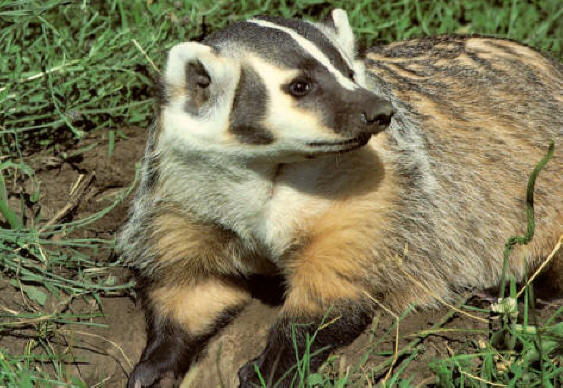
The American Badger is the subject of today's Carnivore Prowl! The American Badger, or Taxidea taxus, is a very intresting and complex creature. The homerange is typically from northern Mexico up to central Canada. 

The American Badger has most of the general characteristics common to badgers; stocky and low-slung with short, powerful legs, they are identifiable by their huge foreclaws (measuring up to 5 cm in length) and distinctive head markings. Measuring generally between 60 to 75 cm (23.6 to 29.5 inches) in length, males of the species are a little bit larger than females (with an average weight of roughly 7 kg (15.5 pounds) for females and up to almost 9 kg (19.8 pounds) for males). Northern subspecies such as T. t. jeffersonii are heavier than the southern subspecies. In the fall, when food is plentiful, adult male badgers can exceed 11.5 kg (25.3 pounds). That's a big badger!


The American Badger is a fossorial carnivore It preys predominantly on pocket gophers, ground squirrels, prairie dogs, wood-rats, kangaroo mice, deer lice, and voles, often digging to pursue prey into their dens, and sometimes plugging tunnel entrances with objects. They also prey on ground-nesting birds such as bank swallow and burrowing owl, lizards, amphibians, fish, skunks insects, including bees and honeycombs and some plant foods such as maize, peas, green beans, mushrooms and other fungi, and sunflower seeds.
They are mainly active at night, but may be active during the day. They do not hibernate, but become less active in winter. A badger may spend much of the winter in cycles of torpor that last around 29 hours. They do emerge from their setts on warmer days.
Badgers sometimes use abandoned burrows of other animals like foxes or animals slightly smaller or bigger. Badgers are normally solitary animals for most of the year, but it is thought that in breeding season they expand their territories to actively seek out mates. Males may breed with more than one female. Mating occurs in the summer, but implantation is delayed and the young are born in an underground burrow during late winter. Litters consist of one to five offspring.
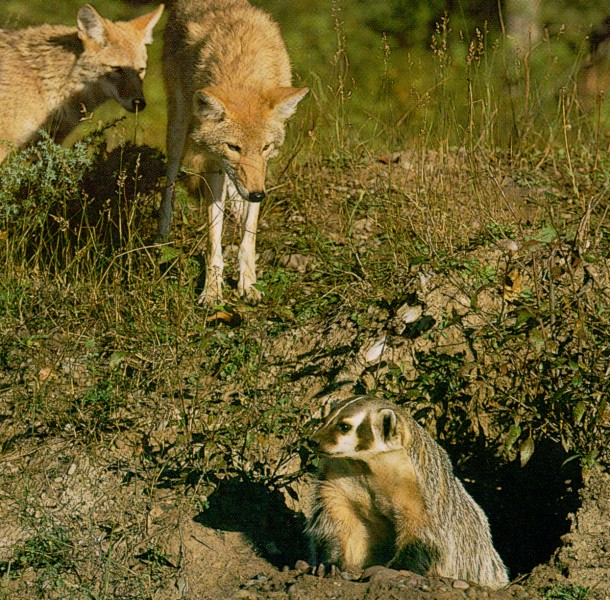
 THE MOST INTERESTING PART is that: American badgers will sometimes form a symbiotic relationship with coyotes. Because coyotes are not very effective at digging rodents out of their burrows, they will chase the animals while they are above ground. Badgers on the other hand are not fast runners, but are well-adapted to digging. When hunting together, they effectively leave little escape for prey in the area.

Derek C. Herrington


Tuesday, August 31, 2010

Monday's CRAZY BIRD


Today's Crazy Bird is the  Cassowary! 

All cassowaries have feathers that consist of a shaft and loose barbules. They do not have retraces (tail feathers) or a preen gland. Cassowaries have small wings with 5-6 large remeges. These are reduced to stiff, keratinous quills, like porcupine quills, with no barbs. A claw is on each second finger. The furcula and coracoid are degenerate, and their patalal bones and sphenoid bones touch each other. These, along with their wedge-shaped body, are thought to be adaptations to ward off vines, thorns and saw-edged leaves, allowing them to run quickly through the rainforest.
A cassowary's three-toed feet have sharp claws. The second toe, the inner one in the medial position, sports a dagger-like claw that is 125 millimetres (5 in) long. This claw is particularly fearsome since cassowaries sometimes kick humans and animals with their enormously powerful legs (see Cassowary Attacks, below). Cassowaries can run up to 50 km/h (31 mph) through the dense forest. They can jump up to 1.5 metres (4.9 ft) and they are good swimmers, crossing wide rivers and swimming in the sea as well.
All three species have horn-like but soft and spongy crests called casques on their heads, up to 18 cm (7 in). These consist of "a keratinous skin over a core of firm, cellular foam-like material". Several purposes for the casques have been proposed. One possibility is that they are secondary sexual characteristics. Other suggestions include that they are used to batter through underbrush, as a weapon for dominance disputes, or as a tool for pushing aside leaf litter during foraging. The latter three are disputed by biologist Andrew Mack, whose personal observation suggests that the casque amplifies deep sounds. However, the earlier article by Crome and Moore says that the birds do lower their heads when they are running "full tilt through the vegetation, brushing saplings aside and occasionally careening into small trees. The casque would help protect the skull from such collisions." Mack and Jones also speculate that the casques play a role in either sound reception or acoustic communication. This is related to their discovery that at least the Dwarf Cassowary and Southern Cassowary produce very-low frequency sounds, which may aid in communication in dense rainforest. This "boom" is the lowest known bird call, and is on the edge of human hearing. The average lifespan of wild cassowaries is believed to be about 40 to 50 years. The cassowary is an endangered species that, in my opinion deserves to stay for generations to come so that others can experience their beauty and uniqueness. If you'd like to play a part in saving the southern cassowary you can go here.
Derek C. Herrington~

Monday, August 30, 2010

An Introduction from the Author

Hello readers. Welcome to the Without the Wild blog. I'm your author, Derek Herrington. I'm a young college student majoring in Fisheries and Wildlife Biology. It's my supreme goal to get my degree and be close to nature. I may not be the best writer you have ever read from, but I hope my blog will be one of entertainment as well as a learning experience. 
We have a few themed days: 

Mondays will be: Crazy Bird.
Wednesday will be: Carnivore Prowl.
Friday will be: Nature Landscape.

There will be three different themes every week while regular reads are still being published. I hope you enjoy the blog.