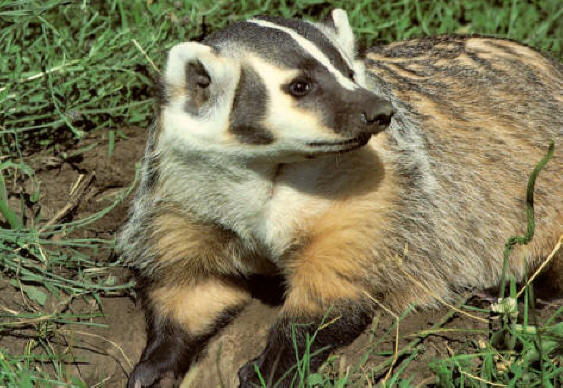
The American Badger is the subject of today's Carnivore Prowl! The American Badger, or Taxidea taxus, is a very intresting and complex creature. The homerange is typically from northern Mexico up to central Canada.
The American Badger has most of the general characteristics common to badgers; stocky and low-slung with short, powerful legs, they are identifiable by their huge foreclaws (measuring up to 5 cm in length) and distinctive head markings. Measuring generally between 60 to 75 cm (23.6 to 29.5 inches) in length, males of the species are a little bit larger than females (with an average weight of roughly 7 kg (15.5 pounds) for females and up to almost 9 kg (19.8 pounds) for males). Northern subspecies such as T. t. jeffersonii are heavier than the southern subspecies. In the fall, when food is plentiful, adult male badgers can exceed 11.5 kg (25.3 pounds). That's a big badger!

The American Badger is a fossorial carnivore It preys predominantly on pocket gophers, ground squirrels, prairie dogs, wood-rats, kangaroo mice, deer lice, and voles, often digging to pursue prey into their dens, and sometimes plugging tunnel entrances with objects. They also prey on ground-nesting birds such as bank swallow and burrowing owl, lizards, amphibians, fish, skunks insects, including bees and honeycombs and some plant foods such as maize, peas, green beans, mushrooms and other fungi, and sunflower seeds.
They are mainly active at night, but may be active during the day. They do not hibernate, but become less active in winter. A badger may spend much of the winter in cycles of torpor that last around 29 hours. They do emerge from their setts on warmer days.
Badgers sometimes use abandoned burrows of other animals like foxes or animals slightly smaller or bigger. Badgers are normally solitary animals for most of the year, but it is thought that in breeding season they expand their territories to actively seek out mates. Males may breed with more than one female. Mating occurs in the summer, but implantation is delayed and the young are born in an underground burrow during late winter. Litters consist of one to five offspring.
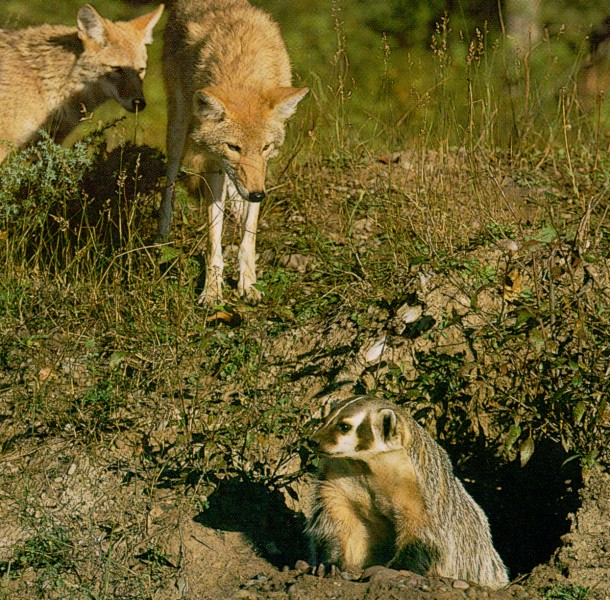
THE MOST INTERESTING PART is that: American badgers will sometimes form a symbiotic relationship with coyotes. Because coyotes are not very effective at digging rodents out of their burrows, they will chase the animals while they are above ground. Badgers on the other hand are not fast runners, but are well-adapted to digging. When hunting together, they effectively leave little escape for prey in the area.
Derek C. Herrington
